Scientists Capture Solar Eclipse Data from 'Flying Observatory' Plane
Irish scientists successfully captured data during a total solar eclipse from an Irish Air Corps plane flying into the path of totality. The mission aimed to study the Sun's outer atmosphere, the corona, and its magnetic field.
Key takeaways
- An Irish Air Corps plane served as a flying observatory for scientists studying a total solar eclipse.
- The mission captured crucial data on the Sun's corona and magnetic field from 540km off the Irish coast.
- Researchers from multiple Irish institutions and Italy participated in the year-long planned expedition.
- Scientists successfully obtained observational data within the two-minute window of totality.
What Happened
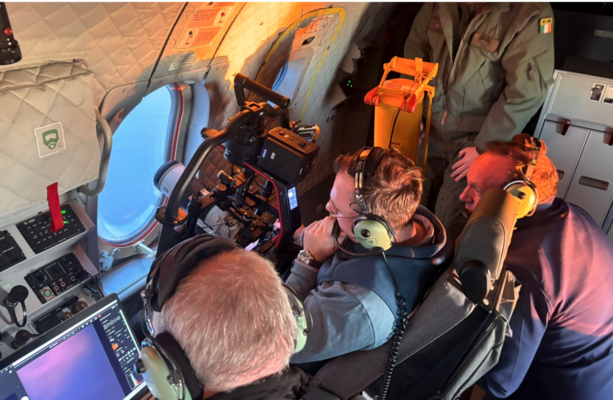
A team of Irish and Italian scientists conducted an experiment aboard an Irish Air Corps aircraft to observe a total solar eclipse. The mission, planned for over a year, involved flying into the path of totality approximately 540-550 kilometers west of Ireland.
The scientists aimed to study the Sun's outer atmosphere, the corona, and the magnetic fields that influence it. During a total solar eclipse, the moon blocks the sun's disc, revealing the faint corona which can reach temperatures of around two million degrees Celsius.
Researchers from the Dublin Institute for Advanced Studies (DIAS), Trinity College Dublin, Technological University Dublin, and Italy's National Institute for Astrophysics (INAF) were on board. The aircraft, an Irish Air Corps C295, provided a stable platform for a newly developed telescope called E-CorMag.
Key Facts
- Scientists flew into the path of totality for a solar eclipse, approximately 540-550 kilometers west of Ireland.
- The mission aimed to study the Sun's outer atmosphere (corona) and its magnetic field.
- The team had a window of about two minutes to capture scientific data.
- Researchers from DIAS, TU Dublin, TCD, and INAF participated.
- A new telescope, E-CorMag, was used for the experiment.
- The plane descended to approximately 10,000 feet to allow for data collection.
- Preliminary data includes optical, infrared, and green-line images, which may help determine the Sun's temperatures and magnetic field.
Background
Previous missions have sought to understand the high temperatures of the solar corona compared to the sun's interior. Scientists are particularly interested in the role of the Sun's magnetic field in phenomena like coronal heating.
The Dunsink Observatory, involved in this mission, has a history of significant astronomical contributions, including involvement in experiments that helped prove Albert Einstein's Theory of Relativity in 1919.
Sources reviewed
Project Chintan independently synthesized and analyzed information cross-checked across the sources listed above.
Related stories

Ancient Brain 'Night Watch' Linked to Poor First-Night Sleep on Trips
2027 'Eclipse of the Century' to Offer Unprecedented Viewing in Middle East, North Africa, and Spain
Perseid Meteor Shower Dazzles Stargazers Worldwide