Cosmic Dawn Reveals 'Black Hole Stars,' Challenging Early Universe Theories
Astronomers have identified a new type of cosmic object, dubbed 'black hole stars,' observed in the early universe. These massive, gas-shrouded black holes emit light resembling stars, challenging existing models of early cosmic evolution.
Key takeaways
- Astronomers have identified a new type of cosmic object called 'black hole stars'.
- These objects are massive black holes surrounded by hot, ionized gas cocoons.
- Observed in the early universe, they emit light resembling stars.
- They are thought to be precursors to supermassive black holes.
- The discovery was aided by observations from the James Webb Space Telescope.
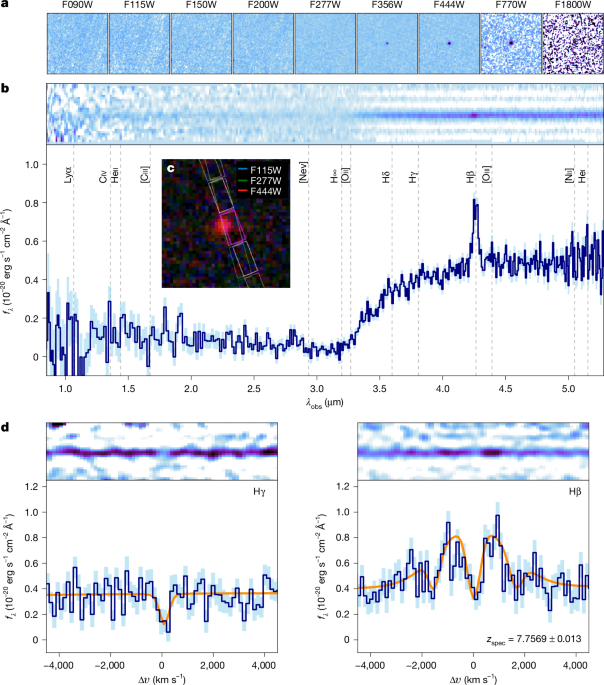
Astronomers have identified a new class of celestial object, termed 'black hole stars,' which are massive, gas-enshrouded black holes observed in the early universe. These objects, first noted as 'little red dots' (LRDs) in images from the James Webb Space Telescope, exhibit characteristics of both stars and black holes.
Scientists propose that these 'black hole stars' are black holes surrounded by dense cocoons of hot, ionized gas. This gas causes them to radiate light, similar to stars, with their crimson color attributed to the gas reddening outgoing light. This phenomenon is comparable to how Earth's atmosphere can tint sunsets red.
The prevalence of these objects in the early universe, roughly within the first 700 million to 1.5 billion years after the Big Bang, suggests they may be precursors to the supermassive black holes found at the centers of modern galaxies. Their intense energy output, far exceeding that of any known star, aligns more closely with that of black holes.
One exemplar of this phenomenon is MoM-BH*-1, observed approximately 660 million years after the Big Bang. Analysis of its spectrum revealed a strong 'Balmer break,' indicating dense hydrogen clouds absorbing higher-energy radiation, a sign consistent with a growing black hole encased in gas.
Researchers believe that 'black hole stars' could play a significant role in galaxy evolution, potentially being the initial stage for the development of supermassive black holes.
Sources reviewed
Primary source: Nature
Additional reporting reviewed
Project Chintan independently synthesized and analyzed information cross-checked across the sources listed above.
Related stories

Total Solar Eclipse Visible in Europe, First Since 1999

Nasa Jet to Chase Solar Eclipse, Studying Sun's Corona

Solar Eclipse: Old Glasses Pose Eye Danger, Swiss Demand New Ones