
Natural Sunlight Successfully Generates Quantum Entanglement in Laboratory Breakthrough
Researchers have demonstrated that incoherent sunlight can replace high-energy lasers to produce entangled photons. This discovery offers a sustainable path for quantum computing and secure space-based communications by leveraging abundant natural light.
Key takeaways
- Natural sunlight can generate quantum entanglement with 94% fidelity compared to laser-based methods.
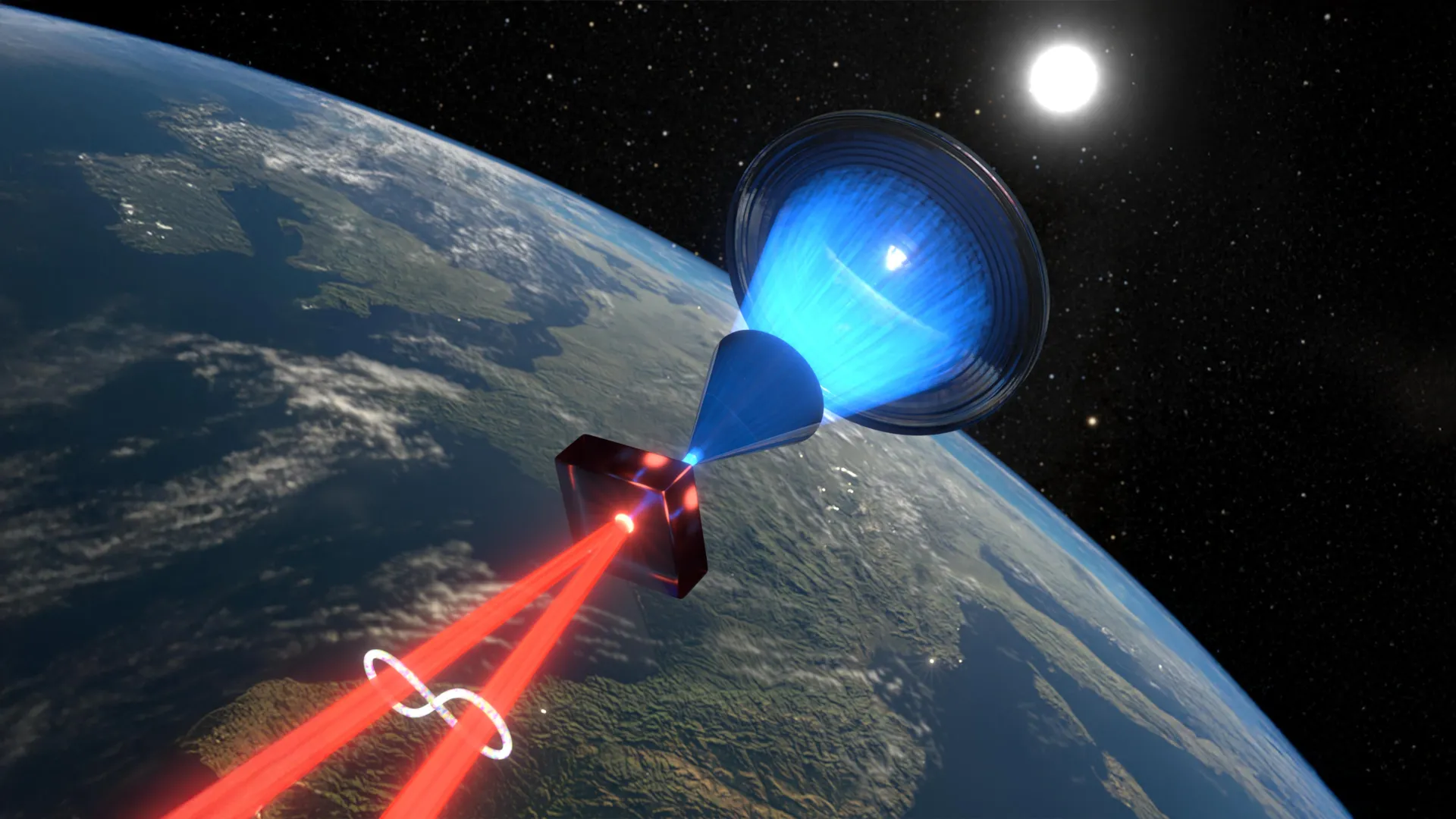
- A custom all-glass solar concentrator was required to focus light onto a one-millimeter nonlinear crystal.
- The findings prove that light coherence is not a strict requirement for creating polarization-entangled photons.
- Solar-powered quantum systems could significantly reduce the energy and hardware requirements for satellites and encryption.
Background
Modern quantum applications, including secure communication networks and high-performance computing, typically rely on energy-intensive lasers. These lasers provide the coherent light traditionally viewed as a prerequisite for generating quantum entanglement. However, as quantum infrastructure expands, the high power consumption of these systems has become a significant industrial concern. Researchers from the University of Ottawa and the Max Planck Institute for the Science of Light (MPL) collaborated to investigate whether natural, incoherent light could serve as a viable alternative.
Key Facts
- The research team utilized spontaneous parametric down-conversion (SPDC) to split single solar photons into entangled pairs within a nonlinear crystal.
- Testing revealed that sunlight-generated entanglement achieved a 94% similarity to perfectly entangled states.
- Measurements confirmed a violation of Bell’s inequality, proving the correlations are quantum in nature rather than classical.
- An all-glass solar concentrator featuring a Fresnel lens was engineered to funnel light from a window-sized area into a fiber the width of a human hair.
- The experimental results were published in the journal Optica, validating theoretical predictions that polarization entanglement depends on oscillation direction rather than color or path.
Why It Matters
This achievement challenges the long-standing assumption that only coherent light sources, like lasers, can produce strong quantum correlations. Cheng Li, the study's lead author, notes that sunlight-driven systems could allow satellites to generate encryption keys using available solar radiation in space. By removing the need for heavy onboard lasers and their associated hardware, this method reduces the weight and energy requirements of quantum-ready spacecraft. Furthermore, the ability to utilize natural light could lower the barriers to entry for scaling quantum computing without increasing the global energy burden.
What Happens Next
Following the successful outdoor proof-of-concept at MPL, the research team is focused on refining the system for practical, non-laboratory environments. Current efforts center on increasing the brightness of the photon source and enhancing the overall quality of the entanglement. While the initial experiment used SPDC, the scientists suggest that other nonlinear optical methods, such as four-wave mixing, could also be adapted for use with sunlight, potentially broadening the scope of solar-powered quantum photonics.
Source: ScienceDaily
Related stories

Operation Safed Sagar Cast Faces Factual Scrutiny in Better Headline Challenge

India's Asia Cup Prospects Threatened as Jemimah Rodrigues Suffers Hamstring Tear
