
EPFO eases withdrawals: 75% of PF accessible for emergencies
India's EPFO simplifies partial withdrawal rules, allowing up to 75% of PF balance for emergencies. A 12-month eligibility period now applies for most advances, with specific caps and frequency for education, housing, and illness.
Key takeaways
- EPFO now allows up to 75% of PF balance to be withdrawn for essential needs, housing, or special circumstances.
- A 12-month membership requirement applies to most advance withdrawals, replacing longer service-based conditions.
- Unemployment provisions permit 75% withdrawal immediately after job loss, with the rest after 12 months of unemployment.
- Medical withdrawals under essential needs are more flexible, with no fixed limit on the number of advances.
- Education and housing withdrawals have defined frequencies (education up to 10 times, housing up to 5 times) within the same 12-month eligibility framework.
What Happened
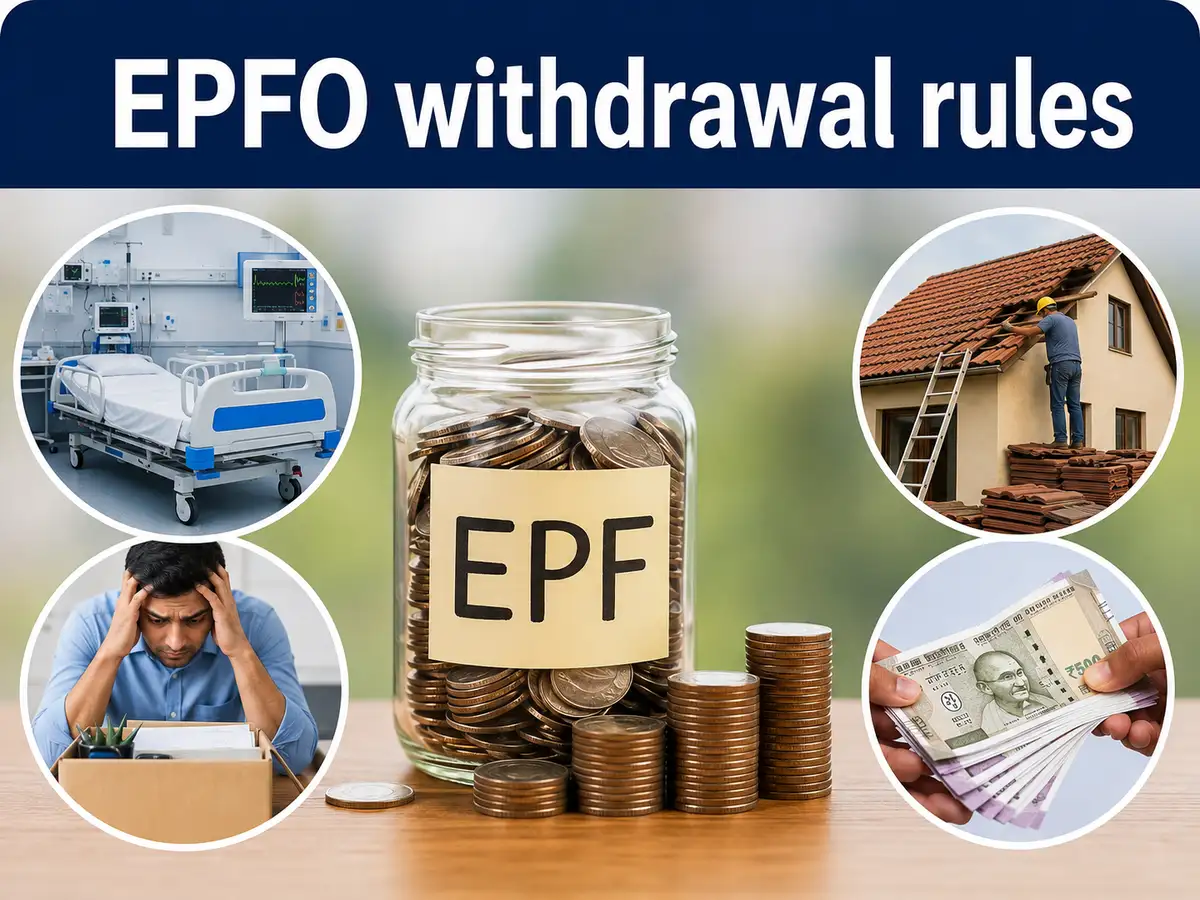
The Employees’ Provident Fund Organisation (EPFO) has simplified and liberalised partial withdrawal rules for its members, expanding access to their provident fund savings during financial emergencies. Officials described a framework under which members can withdraw up to 75% of their PF balance for certain needs, with the remaining balance protected as a future safeguard. The changes also consolidate prior withdrawal categories into three broad heads: essential needs (medical treatment, education, marriage), housing needs (buying, construction, repairs, renovations, and related loan requirements), and special circumstances (up to 75% without specifying a reason).
Key administrative adjustments include a standardised 12-month minimum membership requirement for most advance withdrawals, replacing a prior set of up to seven years of service conditions. For unemployment, members may withdraw up to 75% of their PF balance immediately after becoming unemployed, with the remaining 25% becoming available only after 12 months of continuous unemployment. Previously, the old 1952 scheme allowed withdrawal of the entire PF balance after a short unemployment spell, which led to widespread use of this provision. Medical withdrawals are categorised under essential needs and are now more flexible, with illness-related withdrawals not subject to a fixed limit on the number of times a member can seek an advance, subject to applicable rules.
The reforms also align with broader policy discussions around the EPF Scheme 2026, with government officials highlighting the simplification of partial withdrawals and advances alongside a regime that continues to preserve member contributions, employer contributions, and accrued interest as part of the eligible withdrawal amount.
Why It Matters
The policy shift affects crores of EPF account holders across the organised sector by expanding liquidity during emergencies while retaining a safety net. By standardising the eligibility period and consolidating withdrawal categories, workers gain clearer access to funds for medical, educational, housing, and unemployment-related needs. The changes also introduce or reinforce limits and frequency for various withdrawal reasons, potentially altering how often and for what purpose EPF savings are drawn down. The combination of higher eligible withdrawal amounts and clarified categories could influence financial planning for workers facing job loss, medical costs, or housing-related expenses.
Background
Over the course of the EPF Scheme, debates have centred on balancing member liquidity with long-term retirement security. The current framework references a 12-month membership threshold for most advances and creates a three-category structure for withdrawals, with one category allowing withdrawal up to 75% without detailing a specific purpose. In parallel discussions within Parliament and at the Central Board of Trustees (CBT), the government has described the amendments as part of EPFO 2026, which includes clarifications on partial withdrawals and advances and notes CBT’s role in discussing and recommending changes.
Key Facts
- Withdrawal up to 75% of PF balance permitted for essential needs, housing needs, and special circumstances.
- Unemployment withdrawal: up to 75% immediately after becoming unemployed; remaining 25% after 12 months of continuous unemployment.
- Minimum membership for most advances standardised at 12 months.
- Old rule allowed full PF withdrawal after short unemployment; new rules limit to 75% with a waiting period for the rest.
- Medical withdrawals fall under essential needs with no fixed limit on number of advances, subject to applicable rules.
- EPFO 2026 framework discussed in CBT meeting; amendments placed in the 238th CBT meeting for deliberation and recommendation.
- Education withdrawals: up to 10 times; marriage withdrawals: up to 5 times; illness: no limit; housing: up to 5 times, within 12-month membership and up to 75% of combined employee and employer contributions plus interest.
- Overall eligible amount is 75% of the employee and employer contributions with interest.
What Happens Next
The government indicates continued oversight through the CBT and parliamentary processes, with further details to be implemented as the framework is finalised and communicated to EPF subscribers. Workers may begin planning withdrawals within the clarified three-category structure once the rules are fully operational and published by EPFO.
Sources reviewed
Project Chintan independently synthesized and analyzed information cross-checked across the sources listed above.
Related stories
NTA orders re-exams for English, Commerce and Sociology after errors

IMD foresees heavy to extremely heavy monsoon rain across eastern and northern India

Census 2027: 40-question form rolled out for J&K, Ladakh as phase two begins
