Railway Ministry Upgrades Delhi-Mumbai and Delhi-Howrah Corridors with Kavach 4.0
Indian Railways has deployed its upgraded Kavach 4.0 safety system across 2,490 route kilometers, focusing on high-traffic lines connecting the capital to Mumbai and Howrah. The indigenous automatic train protection technology has received nearly ₹4,000 crore in investment through June 2026.
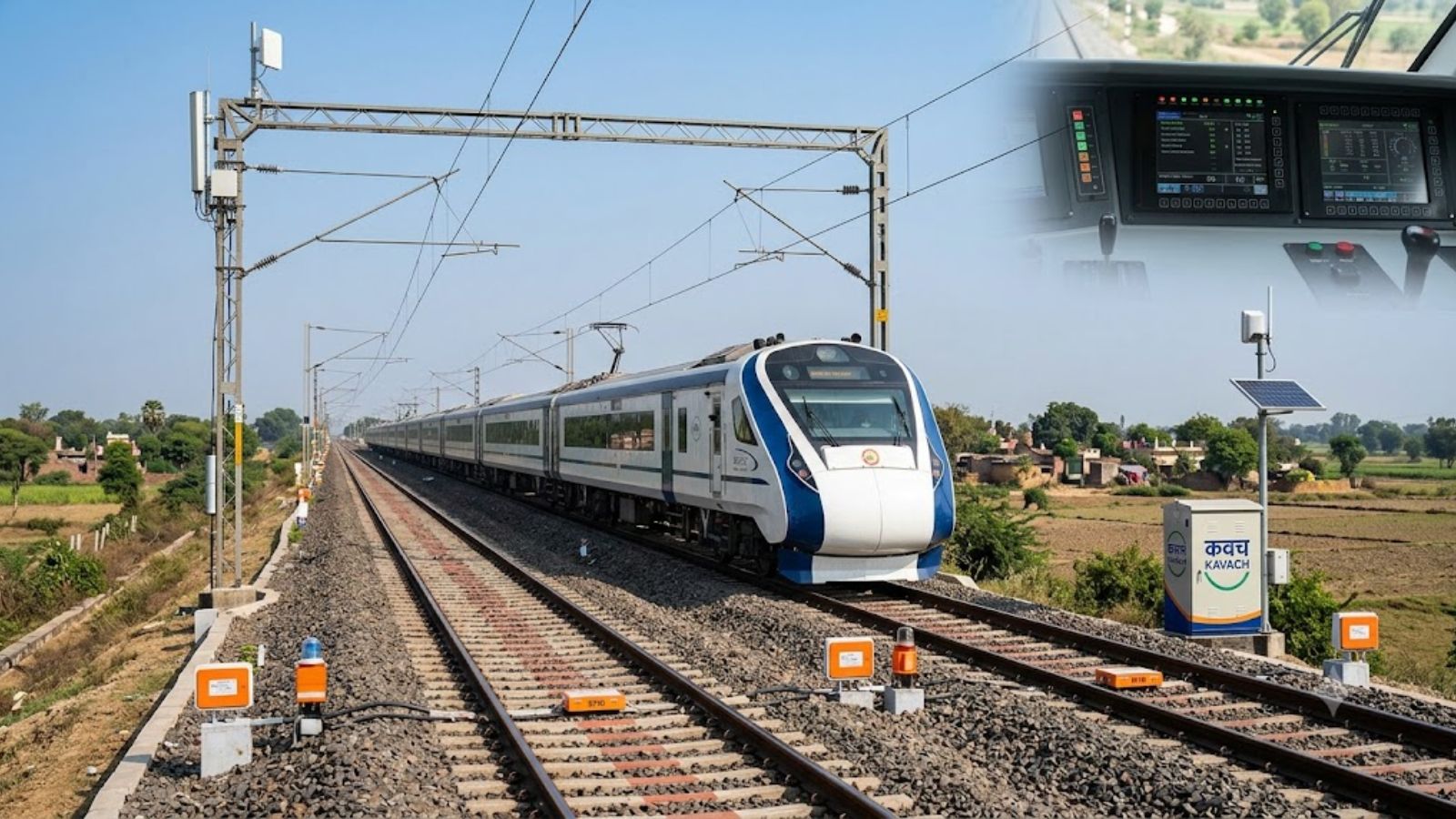
Accelerated Deployment on Strategic Arteries
Indian Railways has reached a significant milestone in rail safety by commissioning the Kavach 4.0 automatic train protection (ATP) system across 2,490 route kilometers (Rkm). This deployment primarily secures the high-density Delhi-Mumbai and Delhi-Howrah corridors. Railway Minister Ashwini Vaishnaw confirmed in a Rajya Sabha statement that the project has transitioned to large-scale implementation following years of field trials and incremental software iterations.
The current coverage is distributed as follows:
- Delhi-Mumbai Route (1,344 Rkm): Key segments include the 1,248 Rkm stretch from Tilak Bridge through Mathura and Vadodara to Virar, along with the 96 Rkm Vadodara-Ahmedabad section.
- Delhi-Howrah Route (1,146 Rkm): Coverage spans 563 Rkm between Chipyana and Subedarganj, 260 Rkm from Chota Ambana to Howrah, and several localized stretches in Bihar and Uttar Pradesh, including the Gaya-Sarmatarn and Kanpur-Lucknow lines.
Technical Evolution and System Capabilities
Initially adopted as the National ATP system in July 2020, Kavach underwent significant refinement before the Research Designs and Standards Organisation (RDSO) approved version 4.0 on July 16, 2024. The latest version introduces enhanced location precision, superior signal handling within complex railway yards, and a direct interface with Electronic Interlocking Systems via optical fiber cables.
Functionally, the system acts as a digital fail-safe. It manages train speeds automatically, triggers braking if pilots fail to respond, and maintains operational continuity during low-visibility weather. The shift from version 3.2—previously installed on 1,465 Rkm of the South Central Railway—to 4.0 followed rigorous Independent Safety Assessments (ISA) and pilot testing that began in February 2016.
Fiscal Pipeline and Infrastructure Progress
Financial commitment to the project remains robust, with ₹3,874.9 crore expended through June 2026. For the 2026-27 fiscal year, the government has earmarked an additional ₹2,066.24 crore. Beyond trackside installation, the Ministry is currently outfitting 7,435 locomotives and 1,200 EMU/MEMU train sets with the necessary hardware.
Infrastructure highlights as of mid-2026 include:
- 11,253 kilometers of optical fiber cable laid.
- 1,668 dedicated telecom towers erected.
- 7,721 route kilometers equipped with trackside technology.
- 958 stations integrated with data centers.
- 6,045 locomotives commissioned with active Kavach units.
The implementation requires a five-pronged logistics strategy: installing station-level Kavach units, placing RFID tags along tracks, erecting towers, laying fiber networks, and ensuring every locomotive in the fleet carries the onboard protection system.
Source: Indian Express