
The other Jantar Mantar protest: When CJP’s ‘Sansad Chalo’ eclipsed Omar Abdullah’s statehood demand
5 min readSrinagarUpdated: Jul 20, 2026 06:11 PM IST
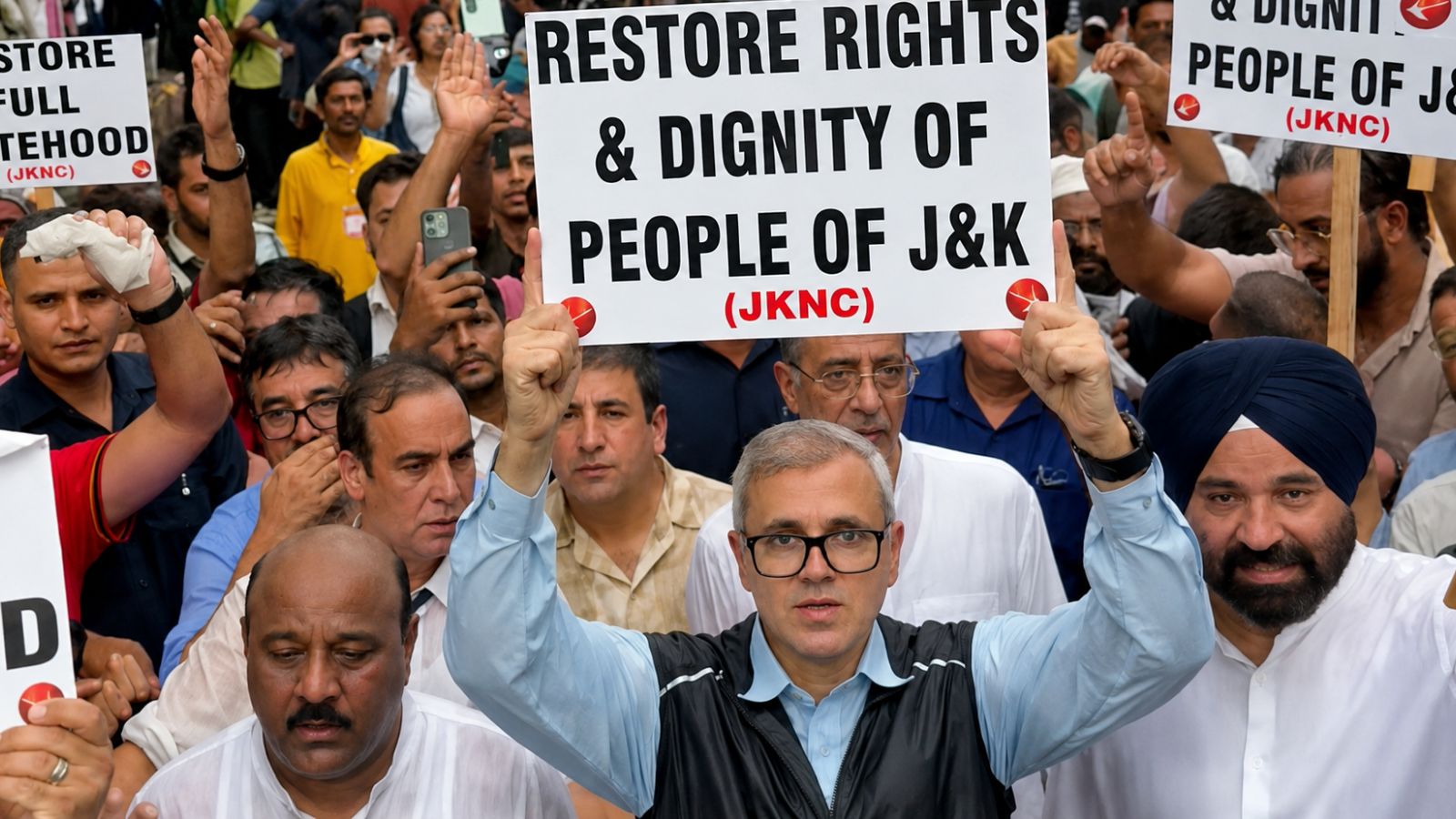
 Jammu and Kashmir Chief Minister Omar Abdullah leading a rally as he was stopped from entering the Jantar Mantar protest site. (Photograb/X@OmarAbdullah/Enhanced using AI)
For its first protest to amplify its demand for restoration of statehood to Jammu and Kashmir, the National Conference chose New Delhi and the first day of the Parliament’s Monsoon Session.
But not only was it eclipsed by the Sansad Chalo march by the Cockroach Janta Party, it also faced a cold shoulder from the National Conference’s India alliance partners.
The National Conference had chosen the national capital in the hope of drawing wider public attention, greater media coverage and support from the leaders cutting across party lines. By limiting its demand to the restoration of statehood – a slogan that enjoys broader political acceptance and for which several political parties had already expressed support – Omar Abdullah’s party appeared to be seeking the widest possible consensus.
But on Monday, the party appeared politically isolated, with only its own leaders, including NC chief Farooq Abdullah, and a handful of Congress leaders from Jammu and Kashmir joining the protest.
“We were stopped from getting to Jantar Mantar and stopped from protesting peacefully for what is rightfully ours but we were not silenced. This is only the beginning of our struggle for statehood, our rights, our dignity and everything that was taken away from us,” Omar posted on X, alongside photos of him sitting next to a Delhi Police barricade.
We were stopped from getting to Jantar Mantar & stopped from protesting peacefully for what is rightfully ours but we were not silenced. This is only the beginning of our struggle for statehood, our rights, our dignity and everything that was taken away from us. pic.twitter.com/tSMwtPLmqI
— Omar Abdullah (@OmarAbdullah) July 20, 2026
In another post, he shared a video of himself in an autorickshaw and wrote, “My walk from Jantar Mantar was about to turn into another procession so we grabbed the first available means of transport.”
My walk from Jantar Mantar was about to turn into another procession so we grabbed the first available means of transport 🛺. pic.twitter.com/R8mtp3hk5X
— Omar Abdullah (@OmarAbdullah) July 20, 2026
“The decision to choose Delhi for the protests was wrong,” says rival Peoples Democratic Party legislator Waheed Para. “The most powerful protest would have been here (in Kashmir), amid your own people.”
There was mismanagement. It was a selfie show and nowhere close to seriousness,” Para said. “Just compare the protest by the youth. The protest visuals were a contrast.”
Although their protest also featured placards demanding “rights and dignity” for the people of Jammu and Kashmir alone, the party was unable to rally its local political rivals behind the event. The NC’s decision to confine its formal demand for statehood, leaving out special status and other constitutional guarantees, did little to broaden support.
Story continues below this ad
Its decision not to permit opposition resolutions on special status and statehood in the J-K assembly further fuelled opposition claims that the party was selective in its commitment to these core issues.
The People’s Conference’s Sajad Lone also questioned the National Conference’s strategy, saying that the resolutions should first come from the J-K assembly and should include the core demands of Article 370 and 35A.
“Taking the issue directly to Delhi without exhausting constitutional avenues within the Assembly would reduce the role of the people of Jammu and Kashmir in the process,” Lone said earlier.
Leaders within the National Conference, too, rued the lack of planning and strategy before “such an important event”. “It is true that the CJP protest plan was announced after ours, but we failed to re-adjust and re-strategise,” a former legislator said. “We could have easily managed a crowd of a few thousand people in Delhi. We didn’t plan for that.”
Story continues below this ad
Former Srinagar Mayor Junaid Azim Mattu posted on X, “A half-hearted, ill-planned, half-baked protest is a disservice to the cause of restoring Kashmir’s dignity and rights. A party with a Government, 40+ legislators and 5 MPs couldn’t invest the effort to gather 5,000 people in Delhi?”
“That the CJP protest over NEET has overshadowed the protest by an elected CM, MPs and MLAs is anguishing even for those who stand opposed to the JKNC politically. What was the need to protest when there was no preparation and no seriousness of intent?” he wrote.
“Why embarrass the people of J&K by this shoddy excuse of a ‘protest’ which looks more like an NC picnic to Delhi? Absolutely disheartening and disappointing. And embarrassing,” he wrote.

Bashaarat Masood is a Special Correspondent with The Indian Express. He has been covering Jammu and Kashmir, especially the conflict-ridden Kashmir valley, for two decades. Bashaarat joined The Indian Express after completing his Masters in Mass Communication and Journalism from the University in Kashmir. He has been writing on politics, conflict and development. Bashaarat was awarded with the Ramnath Goenka Excellence in Journalism Awards in 2012 for his stories on the Pathribal fake encounter. Expertise and Experience Two Decades of Frontline Reporting: Bashaarat has spent 20 years documenting the evolution of Kashmir, from high-intensity conflict and political shifts to socio-economic development. Award-Winning Investigative Journalism: He is a recipient of the prestigious Ramnath Goenka Excellence in Journalism Award (2012). This honor was bestowed for his reporting on the Pathribal fake encounter, a series of stories that highlighted his ability to handle sensitive human rights and security issues with investigative rigor. Specialized Beats: His authoritative coverage spans: Political Transitions: Tracking the shift from statehood to Union Territory, electoral dynamics, and the pulse of local governance. Security & Conflict: Providing nuanced reporting on counter-insurgency, civil liberties, and the impact of the conflict on the civilian population. Development: Documenting the infrastructure, healthcare, and educational landscape within the Valley. Academic Background: He holds a Masters in Mass Communication and Journalism from the University of Kashmir, providing him with a localized academic and professional foundation that is rare in regional reporting. ... Read More
Source: Indian Express


