How Scheduled Castes in Tirunelveli empowered themselves by establishing schools
The community established schools not only in Tirunelveli district but also in other parts of Tamil Nadu. Now, there are 28 schools originally established by the community that are functioning as government-aided primary
In 1924, at a Gurukulam established by V.V.S. Iyer at Cheranmahadevi, Tirunelveli, Brahmin and non-Brahmin students were made to dine separately. This caste discrimination at a Gurukulam played a pivotal role in Tamil Nadu’s politics, with Periyar E.V. Ramasamy leaving the Congress and forming the Dravidar Kazhagam. At a time when this incident shook civil society, the Soosaiappar Primary School on Arasadi Street at Cheranmahadevi, which had completed 50 years, stood out as a shining example of empowerment of the Scheduled Castes (SCs) through education. Students from other castes studied at the school too. The school was founded in 1874 by a prominent Catholic elder from the community without any assistance from Christian missionaries. It now functions as a government-aided primary school.
State-wide drive
The efforts of the SCs in establishing schools were not confined to Tirunelveli district. To empower the community, the community leaders launched similar schools across the State. These institutions were identified as Adi Dravida, long before the term ‘Dalit’ gained currency. Now, there are 28 schools established by the SCs that are functioning as government-aided primary schools in Tirunelveli. A half-a-century ago, there were over 50 such schools.
J. Balasubramaniam, Assistant Professor, Department of Journalism, Madurai Kamaraj University, has studied these schools in Tirunelveli. “It is widely believed that efforts to empower the Dalits through education were led mainly by the British, Christian missionaries, and reform organisations,” he said. Though there is a prevailing notion that the SCs lacked the resources to build institutions, these schools stood testimony to the role of the community in promoting education and social uplift, he said.
In the 1880s, many members of the community migrated from Thiruppanikarisalkulam in Tirunelveli to Colombo (Sri Lanka) where they ran tailoring shops and textile stores and worked as butlers.
School in a hut
Youngsters who returned from Colombo formed the Thiruppanikarisalkulam Youth Association and started a school in a hut in 1885 by appointing a teacher. They collected funds from members of the community in the village and those in Colombo and paid the teacher’s salary. The school received government recognition as a single-teacher aided school in 1924. Until a panchayat union primary school was established in the village in the 1980s, all sections studied at this school. In 1955, 435 students, including 170 girls, were enrolled at the school. Now, it functions with 45 students and four teachers.
“Although these schools were established by the Dalit community, they acted as public schools, open to everyone and were highly inclusive,” said Mr. Balasubramaniam.

Vivekananda Primary School, an Adi Dravidar school started at Vellanguli in 1923 | Photo Credit: Special Arrangement
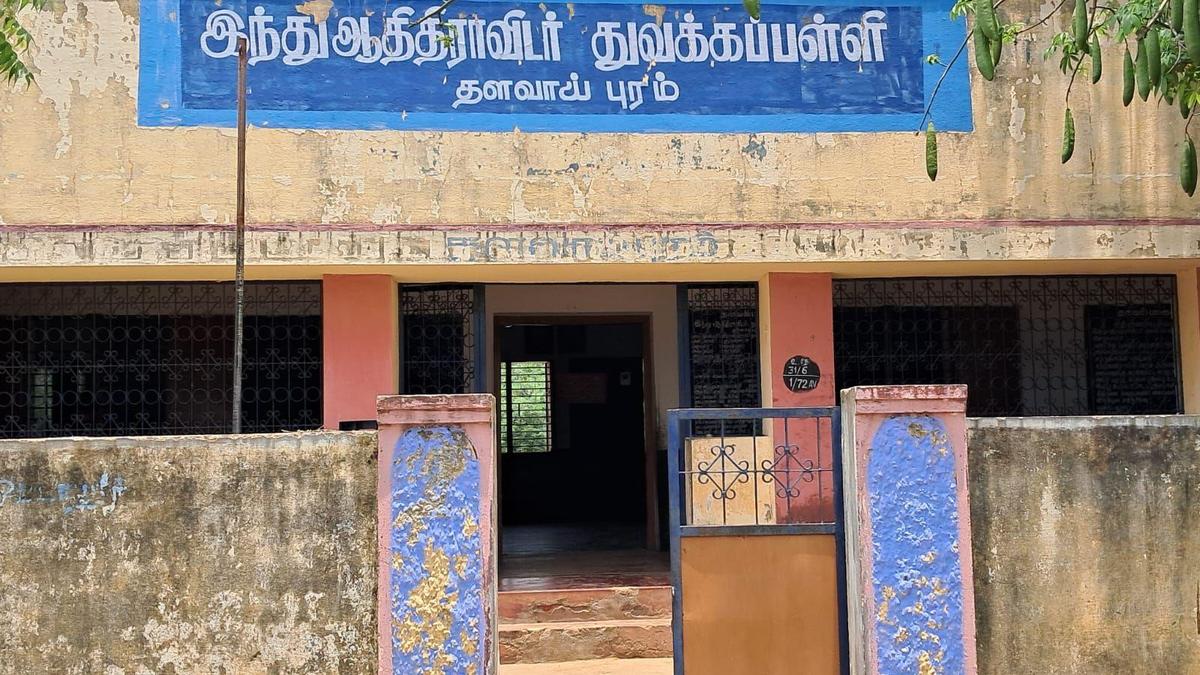
S.S. Periyasamy and Ponnusamy were among the SCs who had worked in Colombo and thereafter became involved in the Adi Dravidar politics and empowerment. They established Adi Dravida schools at Thalavaipuram and Keezha Pappakudi respectively. The school at Keezha Pappakudi is no longer functional. They wrote in the Adidravidan journal, published from Colombo, stressing the importance of education as a means of social uplift. They also wrote against caste discrimination.
Similarly, R.S. Arumugam, a prominent Congress leader, was instrumental in establishing schools in Tirunelveli district. He held responsibilities at the district and State levels in the Harijan Sevak Sangh.
He was thrice elected Member of the Assembly from Gangaikondan (1952-57 and 1962–67) and Ottapidaram (1984-89). He also served as a Member of Parliament (1957-62) from Tenkasi. He was closely associated with J. Shivashanmugam Pillai, the first SC Mayor of Madras and also the first speaker of the Madras Assembly after India’s independence.
It is also important to recognise the role of mutts in the education of the SCs. Despite the prevalence of untouchability, the SCs were not entirely excluded from these institutions. Both Periyasamy and Ponnusamy were in touch with Swami Sahajananda, a SC spiritual leader, who established Nandanar Educational Trust and Mutt in Chidambaram for educating children of the depressed classes in 1916.
In fact, the Thalavaipuram Adi Dravidar School, established by Ponnusamy in Tirunelveli, was initially started under the name, Om Nandanar School, after the Nandanar trust and mutt. Om Prakash Swami, who established the Dakshinamurthy Mutt in Udhagamandalam, was instrumental in the uplift of the SCs through education. In Tirunelveli’s Pappiahpuram, the community established a school named after Om Prakash Swami.
Names changed in line with times
Mr. Balasubramaniam said the names of the schools changed over the years — Adi Dravida, Harijan, Ambedkar — to get government aid and reflect the political climate of the time. The schools adopted the term ‘Harijan’ when it was promoted by Mahatma Gandhi. Later, the community considered the term derogatory and removed it. They also renamed some schools after B. R. Ambedkar. According to Mr. Balasubramaniam, emergence of English medium schools was a major reason for these institutions to lose their importance. “Caste Hindus, who were appointed managers, appropriated them after they became aided schools. Once under the independent administration of the Dalits, these schools were transferred to the control of the Adi Dravidar Welfare Department.”
M. Veldurai, an anaesthesiologist, studied till class 5 at Vivekananda Primary School, an Adi Dravidar school started at Vellanguli in 1923. He is its treasurer. It now functions with 100 students and four teachers. He said these schools would stay relevant only if they were made English- medium schools with more infrastructure.
Source: The Hindu — National