Chief Ministers of Tamil Nadu who were defeated in elections
From the early years of Dravidian politics to more recent decades, voters have not hesitated to defeat stalwarts, even Chief Ministers
In Tamil Nadu’s intensely personality-centric politics, the electorate has repeatedly demonstrated that no leader, however towering, is beyond scrutiny. From the first Assembly election in Madras State in independent India to more recent decades, voters have not hesitated to defeat stalwarts, even Chief Ministers.
The first such instance dates back to the 1952 Assembly elections in which Chief Minister P.S. Kumaraswami Raja (Congress) was defeated in Srivilliputhur by D.K. Raja (Independent).
The next instance was recorded in the watershed 1967 Assembly elections, which fundamentally altered the State’s political landscape. For the first time in independent India, a regional party, the Dravida Munnetra Kazhagam (DMK) came to power, dislodging the Indian National Congress. Since then no national party, independently, has been able to gain the confidence of the people.

In 1967, the elections were held amid extraordinary political ferment. A massive anti-Hindi agitation in the 1960s, led and amplified by the DMK, had swept across the State. Students poured onto the streets, and several lost their lives in police firing. Simultaneously, spiralling prices of essential commodities deepened public anger against the Congress government.
This wave of discontent translated decisively at the ballot box. The then Chief Minister, M. Bhaktavatsalam, contesting from Sriperumbudur (then a general constituency), suffered defeat at the hands of DMK candidate D. Irajarathinam. He lost by a margin of 8,926 votes, polling 41,655 votes. His defeat symbolised the collapse of Congress dominance in the state.
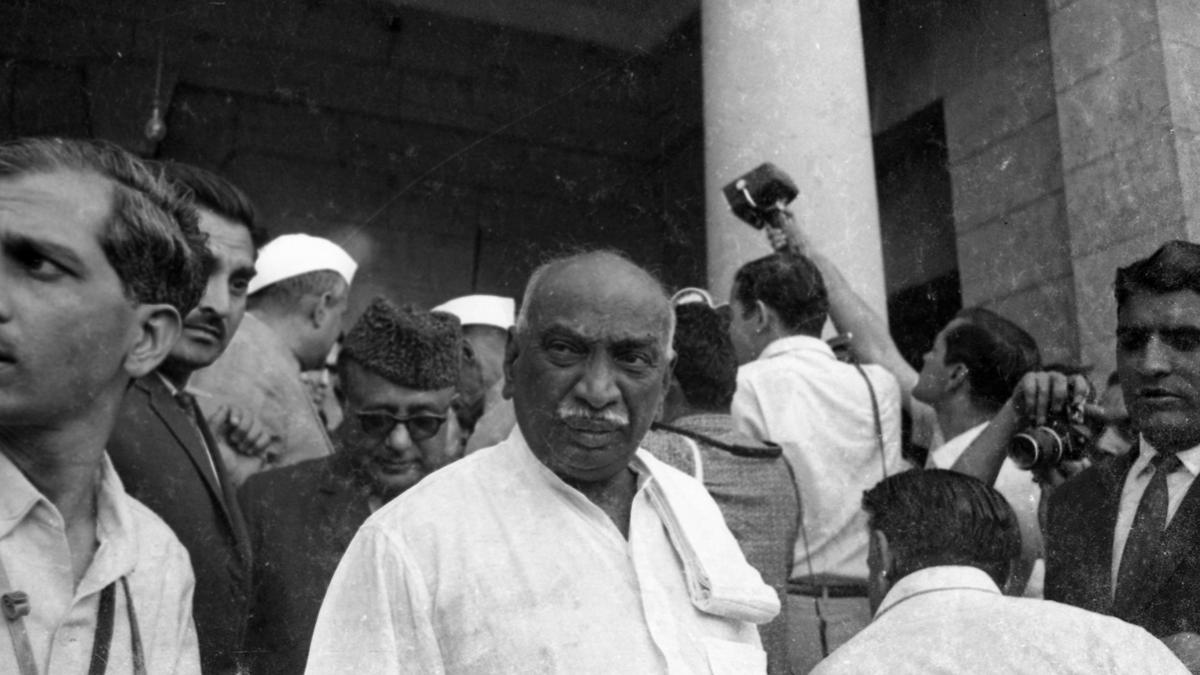
In the same election, one of India’s tallest political figures and Congress national president, K. Kamaraj, also faced an unexpected setback. Contesting from Virudhunagar, the former Chief Minister was defeated by a young DMK student leader, P. Seenivasan, by a narrow margin of 1,285 votes.

According to a UNI report published in The Hindu dated February 24, 1967, Seenivasan said, “I am a poor man and with borrowed cars and limited resources at our disposal; we did our job as well as we could. But for the students’ help this area received, the battle could not have been won.” He said students “did hard work in the rural areas which have no roads or proper communications worth the name. We helped them in their agricultural operations and made them understand we are their friends.”
The scale of the Congress rout in 1967 was striking. Along with Bhaktavatsalam and Kamaraj, five Cabinet Ministers were also defeated. Accepting the verdict, Bhaktavatsalam remarked: “I accept the defeat as the verdict of the people against the Congress. I offer my felicitations to the DMK who will be forming the Government.”
For nearly three decades after 1967, no sitting Chief Minister in Tamil Nadu was defeated in an election. That streak was broken dramatically in 1996, when J Jayalalitha (as her name was spelled then) faced a crushing electoral reversal.

Jayalalitha had come to power in 1991 with a massive mandate, winning from two constituencies, Bargur and Kangeyam, in an election held against the backdrop of former Prime Minister Rajiv Gandhi’s assassination. She had chosen to retain the Bargur seat. However, by 1996, her government had become deeply unpopular. Allegations of corruption, ostentatious displays of wealth, and charges of authoritarian governance fuelled widespread resentment.
The 1996 elections saw a sweeping victory for the DMK-Tamil Maanila Congress alliance. In Bargur, Jayalalitha was defeated by the DMK’s E. G. Sugavanam by a margin of 8,366 votes. She polled 50,782 votes against Sugavanam’s 59,148, a stark reversal from her 1991 triumph when she had won the seat by over 37,000 votes defeating film actor T Rajhendher.
DMK leader M. Karunanidhi famously described Sugavanam’s victory as that of “an ant entering the ears of an elephant.”

Interestingly, towering Dravidian leader and DMK founder C. N. Annadurai, had himself faced electoral defeat earlier, though not as Chief Minister. In the 1962 Assembly elections, Annadurai lost from Kancheepuram to the Congress candidate S. V. Natesa Mudaliar by a margin of nearly 10,000 votes.
In 1967, instead of contesting the Assembly elections, Annadurai chose to enter Parliament by winning the Lok Sabha seat from Madras South. With the DMK securing a sweeping majority in the Assembly, Annadurai was sworn in as Chief Minister and became a Member of the Legislative Council.
Incumbent Chief Minister M.K. Stalin had lost his debut election from Thousand Lights in 1984. He won the seat in 1989 but again lost in 1991.
Likewise, AIADMK general secretary Edappadi K. Palaniswami, who had assumed charge as Chief Minister in 2017 after Jayalalithaa’s passing, had lost to the PMK candidate in his native turf, Edappadi in 1996.
However, M. Karunanidhi, the five-time Chief Minister never lost an Assembly election. He was elected for a record 13 times as legislator.
But even he faced some tough battles. In 1980 — he won in Anna Nagar by just 699 votes with the AIADMK’s H V Hande giving him a run for his money. He stayed away from contesting in 1984.
In 1991, he was the lone DMK candidate to win from Harbour by just 890 votes. He, however, resigned.
AIADMK founder M. G. Ramachandran never lost an election. In fact he won his first and last election from the hospital bed in 1967 and 1984. But his wife Janaki, who took over as Chief Minister after his death, was defeated in her very first Assembly election from Andipatti from where MGR won his last election. She then quit politics.
Three-time Chief Minister and former AIADMK leader O. Panneerselvam has remained unbeaten in Assembly polls since 2001. However, in 2024, he was defeated in the Lok Sabha polls from Ramanathapuram as an Independent candidate. This time he is trying his luck for the first time on a DMK ticket.
This article has been edited to correct factual errors.
Tamil Nadu Elections: Where even the powerful can lose
Tamil Nadu Elections: Where even the powerful can lose | Video Credit: The Hindu
Source: The Hindu — National